

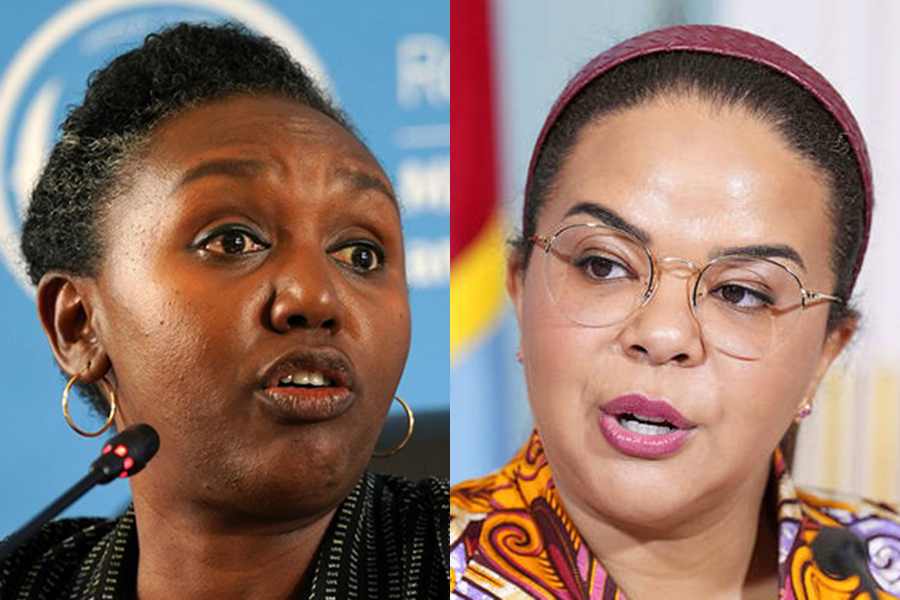
Rwanda and DR Congo took their diplomatic spats on social media on Tuesday, hours after the United States imposed sanctions on the Rwanda Defence Force (RDF) and four of its top commanders for supporting the March 23 Movement (M23) in eastern DRC.
DRC Foreign Minister Thérèse Kayikwamba Wagner welcomed the sanctions as a “turning point” in holding Rwanda accountable for its actions, while taking the opportunity to underscore Kigali’s alleged support for armed groups that threaten regional stability.
“This decision taken by President Donald J. Trump and his administration marks a turning point: a word given cannot be perpetually broken, and the brazen contempt for human lives cannot endure,” Kayikwamba wrote on X.
“At the beginning of Women’s Rights Month, I am thinking first and foremost of Congolese women, who have for too long been at the heart of this cycle of violence.”
In her post, Kayikwamba framed the sanctions as confirmation of the DR Congo’s position: that Rwanda’s continued backing of M23 undermines peace and violates commitments made under the December 2025 Washington Accords.
She also reaffirmed the government’s stance on national unity, writing that under President Félix Tshisekedi and Prime Minister Judith Suminwa Tuluka, the DRC “remains united, indivisible, and standing strong.”
Rwanda government spokesperson Yolonde Makolo did not take the assertion lying down and was as brittle as they come, echoeing the moral language of Kayikwamba’s post but countered with accusations against Kinshasa.
“No one can argue with this — but above the noise, the reality is that the Government of the DR Congo remains the Number One backer of FDLR, which is an existential threat to Rwanda,” Makolo said.
“No matter how many lies and resources are invested into propaganda to distract from DRC state sponsorship of the FDLR, this problem is not going away.”
Makolo also warned that unilateral sanctions risk empowering DR Congo to pursue a military solution rather than peace.
“One-sided sanctions unfortunately only serve to embolden the Government of DR Congo in its insistence on a military solution. The result is what we see now: prolongation of the conflict, escalation of violence, lost opportunities and, importantly, lost lives,” she said.
The sanctions imposed by the United States target RDF senior officials Vincent Nyakarundi, Ruki Karusisi, Mubarakh Muganga, and Stanislas Gashugi, as well as the RDF itself.
The US alleges that the RDF has directly supported M23 with training, weapons, and operational assistance, enabling the group to capture strategic locations, including Uvira, and commit serious human rights abuses.
The Treasury Department blocked all US property and interests of the designated officials and forbade U.S. persons from transacting with them.
While the sanctions drew international attention, analysts note that the main story remains the deepening mistrust between Kigali and Kinshasa. Both governments have long accused each other of backing armed groups in eastern DR Congo — a pattern that continues to fuel cycles of violence and displacement.
Eastern DR Congo has seen repeated clashes between M23, the Armed Forces of the DR Congo (FARDC), and other armed groups, resulting in civilian deaths, forced displacement, and attacks on women and children.
Kinshasa has consistently highlighted Rwanda’s alleged sponsorship of M23 and called for respect of the Washington Accords, which were intended to halt hostilities and foster regional cooperation. Rwanda, in turn, emphasizes the threat posed by FDLR — a group accused of atrocities against Rwandan civilians — and frames its actions as defensive.
Observers say the social media exchanges reflect more than just rhetoric: they underscore a broader struggle over narrative, legitimacy, and control of the eastern DRC conflict.
The sanctions are significant, but they are also being leveraged politically by both sides to strengthen their respective positions.
As humanitarian agencies continue to report violence and displacement, experts warn that sustainable peace will require mutual accountability, full implementation of existing agreements, and active diplomacy between the DR Congo, Rwanda, and international stakeholders.
Without coordinated action, one-sided sanctions and public recriminations risk doing little more than escalating tensions while civilians remain at risk.
